

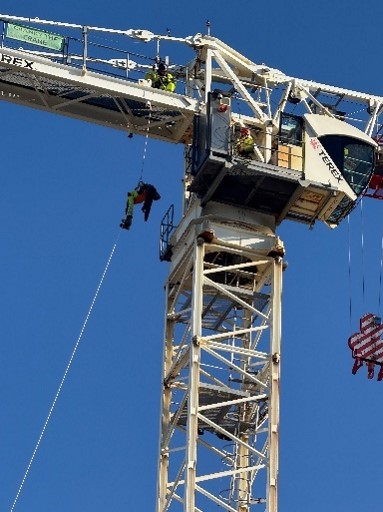
 Mammoet operatives at our Sellafield Product and Residue Store Retreatment Plant (SRP) recently conducted a controlled dummy rescue exercise, using REAX self-descender equipment, to simulate an emergency evacuation from a tower crane.
The drill involved carefully lowering a weighted dummy from the crane, while ensuring stability and control throughout the descent. To manage the speed of descent, and minimise potential acceleration, the team use a Milan hoist which was secured to an anchor point above the casualty’s head.
The team also use a guide rope, this method provides additional stability and guides the casualty away from any structures below.
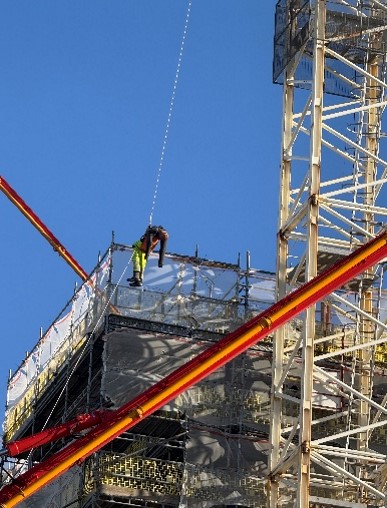
During the operation, a Mammoet operative, positioned below, played a key role in guiding the dummy safely down through an active worksite, navigating between two concrete pumps, positioned approximately 20 metres apart.
The descent was deliberately slowed to reduce momentum, ensuring a controlled and safe landing. Once on the ground, the Mammoet team efficiently removed the REAX rescue equipment, preparing the site for emergency services to take over.
Regular drills
 Mammoet operatives regularly carry out rescue demonstrations at least four times per year. After each drill, the team conducts a debrief to assess areas for improvement.
A previous exercise highlighted that the rescue rope had snagged on scaffolding due to the wind, costing valuable time. In response, the team suggested using a guide rope in a dropped bag rather than manually lowering the rope.
This was the first time the dropped bag method was used, and it successfully saved three to four minutes on the rescue operation.
Dean Clark, site manager, praised the Mammoet operatives for their professionalism during the exercise: “This drill demonstrated the skill and precision of the team in executing a controlled rescue from the tower crane. Their focus on safety, stability, and efficiency ensured the exercise was completed in just three minutes.
“It’s a testament to their training, teamwork, and commitment to maintaining the highest safety standards on site.”