
Leading the future through best practice and collaboration

PPP is full of pride after being awarded the NEC Contracts Award last week at the Martin Barnes Award ceremony.

The award recognised PPP’s pioneering alignment to the NEC4 suite of contracts, with procurement centred around Key Delivery Partners (KDPs) and Tier 3 Frameworks, our SME Matchmaker Service and innovative incentivisation.

The Martin Barnes Awards is an annual event of the NEC Users’ Group under the Institution of Civil Engineers of the United Kingdom to give recognition to projects and organisations around the world that have showcased excellence in project delivery through collaborative partnering.

As the award suggests, it’s been a huge collaborative effort from people spanning different organisations including Sellafield Ltd, PPP, Solomons Europe, Fieldfisher, our KDPs and our SME partners who have all embraced a Project 13 enterprise approach and new ways of working.

John Rossiter, head of supply chain, PPP, said: “I’m incredibly proud of the PPP supply chain strategy and to be part of the team that is changing the dial, creating an enterprise based on commercially aligned, incentivised, long term contracts, which give surety of work, confidence to invest in the region and puts SME innovation into the earliest stages of project delivery.

“This is what the Project 13 Network is all about: an integrated enterprise delivering real outcomes for projects, business and communities, being presented the NEC Contracts Awards helps to recognise what the industry is capable of with the right delivery models.”

James Fennell, head of commercial, PPP Client, said: “This recognition is an example of what we are trying to achieve in PPP, major project excellence through collaboration. What makes this difference is not the Client approach, but how the Client approach has enabled a deeper collaborative ecosystem through multiple supply chain tiers.

“As I was describing at last weeks’ PPP SME Matchmaker event, what we have created is the environment to thrive, now is the time to realise those opportunities and create more! This can only be done when we, with our Lot Partners, KDPs and supporting supply chain, meet our collective commitments and continue to push for more.”

Social Impact team lands two awards in one successful night

It was double delight for our Social Impact team as their hard work and dedication was recognised at two glitzy awards ceremonies in London on Tuesday (2 July) night.

Presented just hours apart, the first acknowledgement was from charity Chapter One at its Partner, Volunteer and School Recognition Event.

Receiving the prestigious Special Recognition Award, PPP was awarded the honour for our employees’ and supply chain’s outstanding commitment to helping primary school age children in our local community develop their reading skills. This would not be possible without the efforts of a growing army of volunteers from PPP, Sellafield Ltd and the supply chain who have provided over 550 hours to Cumbrian pupils on a one-to-one basis every week to provide reading support at the time when they need it the most.

Next was the New Civil Engineer Awards (NCE), where PPP won the Environmental, Social and Governance Leader accolade.

This award recognised those who have demonstrated an innovative approach to environmental and sustainability issues and improving social value.

As part of our application, PPP successfully demonstrated its credentials by focusing on our intern programme and the incredible level of volunteering that takes place across the partnership.

The judges said our entry ‘demonstrated a clear, place-based approach to transforming environmental and social outcomes for a local community, underpinned by a series of robust roadmaps and frameworks that ensured this is strategically prioritised through governance’.

In particular, the judges were impressed by the efforts to publish a strong, quantitative assessment framework for measuring social impact transformation, in what they said ‘bucked the wider industry trend of claiming that these benefits are hard to measure’.

Peter Musk, Head of Change and Transformation, and Cat McChesney-Davies, Social Impact Lead, represented PPP in London.

Peter said:

“We are deeply honoured to receive these awards and they’re incredible recognition for our team, including our supply chain. At PPP, we truly believe in giving back to the community we serve and in supporting future generations.

“To be recognised by Chapter One shows our teams’ dedication to such an amazing initiative and reflects our values and commitment to making a positive impact on the next generation. We are extremely proud to contribute to Chapter One and the educational journey of local schoolchildren and look to do even more in the coming years.

“To win the NCE award for our environmental and sustainability work was equally as proud a moment for us because a huge amount of work has been put into developing our strategy in line with Sellafield Social Impact Multiplied (SiX) and our approach to sustainability.

“There was seriously strong competition and we’ve demonstrated our position as leading the way.”


Thank A Colleague scheme turns one-year-old

The Thank A Colleague scheme turns one year old this month – with nearly 500 nominations made to date.

As we mark one year of celebrating our colleagues across the programme we would like to share some of the highlights, which align to the PPP DNA of promoting flourishing people and inclusion.

During the last 12 months we have had:

  • 488 nominations (up to the end of May 2024)
  • RAP leads the way on the projects, with the most nominations at 31%
  • 18% of PPP colleagues have participated in the scheme
  • On average 40 nominations are made per month
  • 81% of nominations are for individuals and 19% for teams

All the monthly nominations go before members of the People Forum to deliberate on the winners for that month.

Bev Gray, SWMRF Project Administrator, who sits on the People Forum explained:

“We get sent the nominations on a spreadsheet with all the names removed so we don’t know who is nominated or by whom so there is no bias.

“Then we individually score each nomination and then come together for a meeting to discuss, which is great to get everyone’s viewpoints. And the highest scoring nominee wins the award.

“I think it is one of the best ideas we have had on PPP. A thank you can go such a long way. It is really nice, even if you don’t win, to be recognised for what you have done.”

The scheme celebrates people’s achievements and allows employees to feel more confident in their role when appreciated by their peers and management, helping everyone flourish.

PPP Project Director John Griffin, said:

“The Thank a Colleague Scheme provides the whole of the PPP family a fantastic opportunity to show real appreciation to our colleagues.

“Acknowledging achievements via the scheme can make team members feel proud and boost their motivation.

“Peer recognition can create a strong bond among team members and foster a supportive work environment. Employees who feel appreciated report better job satisfaction and reduced stress levels contributing to overall well-being.

“By incorporating appreciation into the PPP DNA, we are not only creating a more positive environment but also setting the Programme up for future success with our flourishing people.”

Nominating a colleague is really simple just click the link:  PPP Thank a Colleague (mcas.ms).

There are five different categories to choose from:

  • PPP Spotlight award: to draw attention to a success, team or individual who has achieved something special.
  • PPP Way Champion Award: for someone who has embraced our collaborative way of working with colleagues across our partners/supply chain/Sellafield.
  • Project Excellence Award: to highlight an individual or a team who has contributed to the performance of our major projects.
  • Outstanding Contribution Award: to recognise someone who goes above and beyond for Team PPP.
  • Zero Harm Award: to recognise an individual who has made a significant positive contribution to the health and safety performance within the project, programme or in their community. 

Submit the form by the end of each calendar month for your nominee to be in with a chance of winning.

Collaborative language and visual tools will assess design maturity

PPP now has its very own collaborative language and visual tools in the model which assesses design maturity on its projects.

Taking Learning From Experience (LFE) from SRP and SCP major project baseline setting, PPP Services investigated opportunities to improve the design maturity definition and assessment process.

Kathryn Smith, PPP Programme Engineering Lead, said:

“A question we got asked a lot was how mature is the design, is it completed? And due to many factors the answer can be variable.

“We looked at various industry standards and those of our partners but found we did not have a common language. We used partner best practice to create a PPP application of Object Management and the Stage Build process, which defined the maturity of the design.

“This is now a common language we have developed for engineering, construction and supply chain so that everybody knows where the design is up to and what they have to do.”

Information is put into a model, which is then colour coded so people can see at a glance where the design maturity is at.

These processes support improved Engineering, Procurement and Commissioning (EPC) delivery and the delivery of the digital model containing all the information.

This provides in-project assessment tools and also support projects to demonstrate the maturity of the design to partners, client and external stakeholders.

This was initially trialled on RAP, testing the process in a design that was well underway.

BEPPS2 has taken this learning and embedded this process into normal delivery. The project can now provide visualisations of the design maturity to supporting understanding across the functions.

And LSS1 are embedding Object Maturity from the outset, planning transition points between the Aligned Delivery Team (ADT) and Key Delivery Partners (KDPs) to deliver the optimum outcomes for the client.

Tony Harwood, Deputy Project Engineering Manager  for LSS1, said:

“The Object Management approach has provided the project with a clear set of guidelines for maturing the design which can be easily communicated and understood by all.

“It has allowed clarity of communication and reporting across the whole delivery team without the need for technical specialism.  It is enabling a consistency of approach across all the engineering team to be built into our plans for the next phase starting from a strategic outline with flexibility to the needs of each project.

“The granularity of the specific rulesets mean every member of the team should be clear on the expectations so we can ensure the design is underpinned and progressed to the right level at the right time.  The alignment with a range of industry practices has meant we can onboard team members from diverse backgrounds and experiences quickly and efficiently to deliver.

“The expectation is that the use of Object Management embedded from the start of the delivery phase will allow regular clear tracking of metrics, quantities and uncertainties such that there are no surprises for our client and the project stakeholders.”

Glossary of terms:

  • Major project baseline: Is the baseline for cost, schedule and risk which are set for remaining engineering, construction and inactive commissioning of the facility. It is the baseline which the partners are incentivised against.
  • Design maturity: A measure of the required definition of a design at any point in the design process. It is the combination of object maturity and required deliverables for any given system.
  • Object maturity management: A common language that explains how far the model is through the design process.
  • Stage build: An assurance process to check the design is at the right point for a funding gate. 
  • Key Delivery Partner: Long-term supply chain partner / supplier.

Life Saving Principles Launch – June 2024

Setting a benchmark for workplace safety is the goal – and, building on our Golden Rules, we are set to launch new Life Saving Principles.

These are aimed at strengthening our culture of Knowingly Safe across all Major Projects. They will target ten high risk areas and outline non-negotiable behaviours and controls that must be applied.

Designed by the Health, Safety and Wellbeing (HSW) Hub, these actions and controls could save your life – or that of a colleague!

These principles set out the non-negotiable arrangements to:

• Promote consistency in the way we manage safety

• Prevent injury to workers and others who may be affected by our activities and

• Minimise losses through damage to plant and equipment.

These principles will also be cascaded down our supply chain so that everyone can stay Knowingly Safe today and continue to be safe tomorrow.

There are ten Life Saving Actions which include: Working at Height; Scaffolding; Mechanical Lifting; Confined Spaces; Fire Prevention; Occupational Health; Ground Disturbance; Electricity; Plant and Machinery and People Plant Interface.

Duncan Elliott, Head of PPP, said:

“We will build a Knowingly Safe culture delivering industry leading health, safety and wellbeing performance through worker trust, teamwork, empowerment, and strong alignment, eradicating life changing events across major projects. These Life Saving Principles are non-negotiable and essential to ensure everyone goes home to their family and friends healthy, safe, and proud of their contribution to fulfilling these principles. Having the courage to use your SAFER stop work authority to protect yourselves or a colleague is the key to ensuring we flourish in everything we do.”

Andy Sharples, Projects Director for Sellafield Ltd said:

“Our work must be carried out safely and with a focus on high standards of quality and assurance, with people encouraged to maintain a diligent and questioning attitude to their roles, drawing on past experiences. Within the Major Project Directorate (PDD) we are committed to achieving excellence in health, safety and environmental (HS&E) management, and our vision is to achieve a culture of ‘Knowingly Safe’ for people and the environment during the lifetime of our major projects and our legacy at Sellafield.

“What we construct today – and how we construct it – will affect the health, safety, and environment of future generations. The quality of construction relates directly to the integrity of the structures that we are building, and in turn our ability to provide Sellafield Ltd safe and harm free nuclear facilities to operate.”

Over the coming months we will highlight each principle in full, alongside any supporting actions to try and ensure we create a safe environment for all employees wherever they work.

Taylor Hoskins, Senior Health and Safety Advisor, will be attending project briefings over the coming weeks to go over the Life Saving Principles in full.

All resources and material will be rolled out next week through the usual EHSSQ channels, so watch this space.

NG Bailey: Award for critical safety intervention

Two NG Bailey electricians have been hailed for a critical safety intervention that potentially halted a serious incident.

Greg Henderson and Daniel Dickinson were working for NG Bailey on the Sellafield Product and Residue Store Retreatment Plant (SRP) when they had a mobile elevated work platform (MEWP) delivered to the site.

During the initial pre-use checks of the Skyjack Scissor MEWP, they discovered that the protective handrail around the basket had become detached, due to a fault with the securing bolt that holds the two handrail sections together.

This quick identification and action prevented a potentially serious incident to keep everyone on PPP Knowingly Safe.

In recognition of their diligence and commitment to safety, Greg and Daniel were presented with Value Awards by Kent Fearon, NG Bailey – SRP Safety Manager.

He said: “This incident highlights the critical importance of the pre-use checks on equipment.

“These awards celebrate individuals who go above and beyond, clearly demonstrating our core values, particularly regarding safety. Well done, Greg and Daniel, on your outstanding contribution.”

BEPPS2 take time out to celebrate World Environment Day

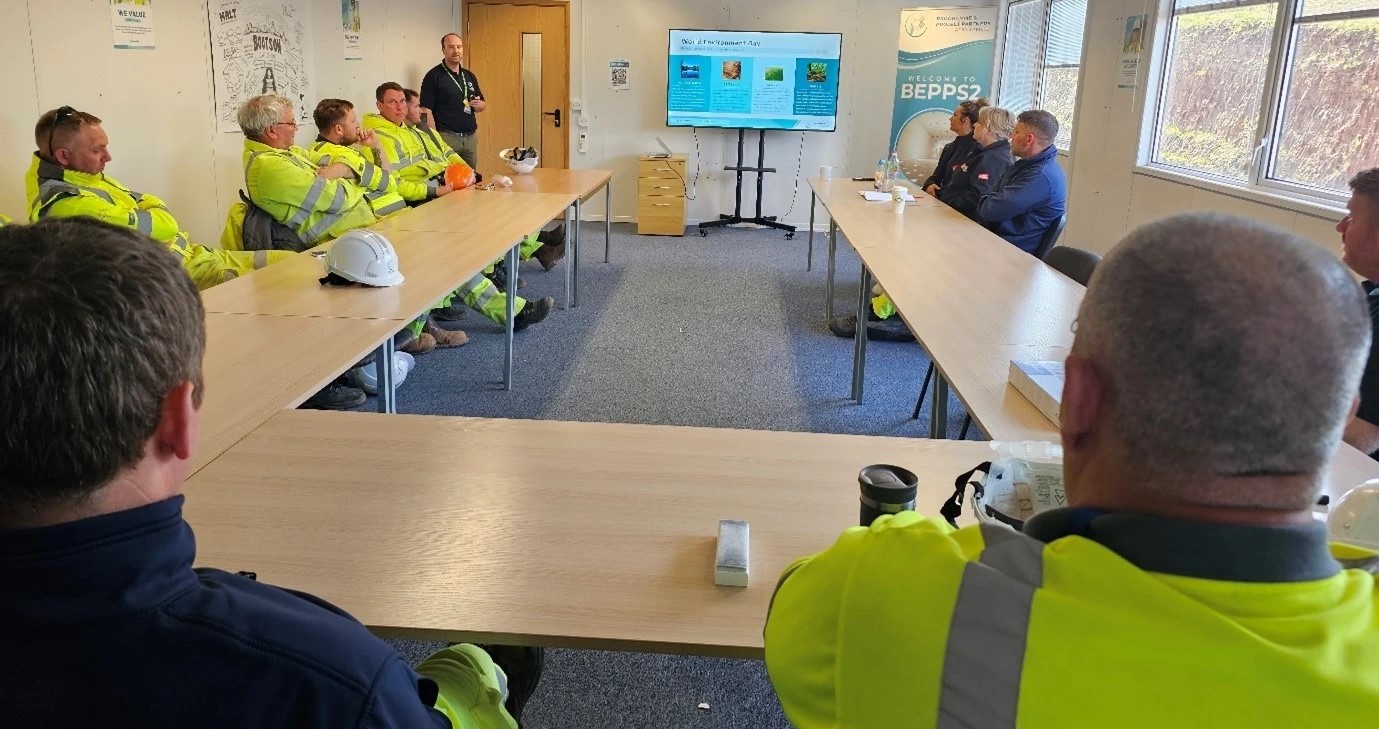
Colleagues on BEPPS2 took time out last week to focus on World Environment Day and how what we do today can affect future generations.

Sarah Dickie, SHE Advisor, created a presentation shown to all site-based personnel, focussing on UN sustainability goals, the impact on the environment globally and locally due to environmental changes.

A short session on the BEPPS2 spills procedure and basic spills training such as source, pathway and receptor, was conducted. This culminated in an on-site spills kit exercise with the on-site team.

Christopher Clark, SHE Manager for BEPPS2, said:

“We reflected on how we can influence future generations to improve and protect the environment and how we can make personal environmental pledges to do our bit for our world and the environment, this included some practical examples.

“Overall the session was really well received by our teams and we have had some really positive feedback through observation cards and the QR code.”

MEWP Standard is raising the bar

Bringing everyone home safely is a key objective across Major Projects at Sellafield – and the new Mobile Elevated Work Platforms (MEWP) standard launched by the Health, Safety and Wellbeing Hub, aims to do just that.

A Major Projects MEWP Co-Ordinators Engagement Day was held at Whitehaven Golf Club to bring together the Hub, PDD and PPP leaders, the supply chain and key MEWP suppliers.

The aim was to assess the new standard and see how it is being received and applied across the projects.

Within the construction industry, there are three times the amount of incidents involving Mobile Elevated Work Platforms (MEWP) compared to any other industry.

And we want to get ahead of that curve and ensure that everyone working with a MEWP is Knowingly Safe and the new standard will help ensure that.

By combining how we co-ordinate MEWP work, how we manage it through plans and procedures and then utilising the best technology available we hope to ensure that we can complete high risk work activities safely.

Following a fatality involving a MEWP during the construction of Everton FC’s new stadium, Jack Tomlinson (PPP EHS Improvement Manager), Karl Hine (Severfield EHS Lead) and Mark Atkinson (SRP Snr EHS Advisor) were asked to develop a spoke to work on MEWP management.

The spoke looked at best practice across the main Key Delivery Partners (KDPs) supply chain partners and the wider construction industry to come up with what is now the Sellafield Project Delivery Directorate (PDD) MEWP Standard.

The new standard looks at improved safety measures, using technology, a project specific MEWP management plan, increased operative competency and introduces new roles for supply chain MEWP Co-ordinator and project MEWP co-ordinators.

Duncan Elliott, Head of PPP, said:

“We want to give everyone a working environment to do the right things to make us Knowingly Safe and get the wider industry into a better place.

“It is about wanting to lead the industry but also there is a strong moral pull. In 2024 people are still being killed in the construction industry and that is unforgivable. We want to do something about that.”

Jack Tomlinson, PPP EHS Improvement Manager & MEWP Spoke Lead, said:

“Many people will remember the Government campaign about car seatbelts ‘clunk click, every trip’, launched at the time it was acceptable not to wear seatbelts.

“However because of targeted campaigns and technology, the use of seatbelts hit the ‘tipping point’ and now it is clearly unacceptable not to use seatbelts.

“We have used this approach to MEWPs. The technology is available and we must use it to bolster safe working practices during this high hazard task. I am exceptionally proud of the MEWP spoke’s work on this and it’s inspiring to see the leap we have made.”

Steve Harnwell, PPP Delivery Director for construction projects, added:

“We do a lot of work at height and part of that is using these MEWP platforms which, in itself, while safer, does present danger.

“This standard is to bring the best practice, best machines, best features in using technology with people to make people safer.

“That’s about being Knowingly Safe so people turn up at work and leave as they have arrived, back to their families.”