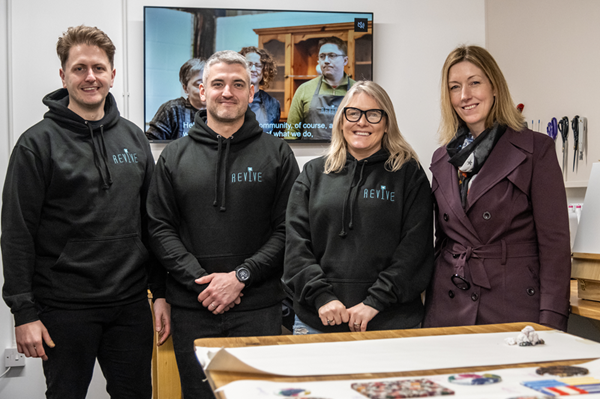
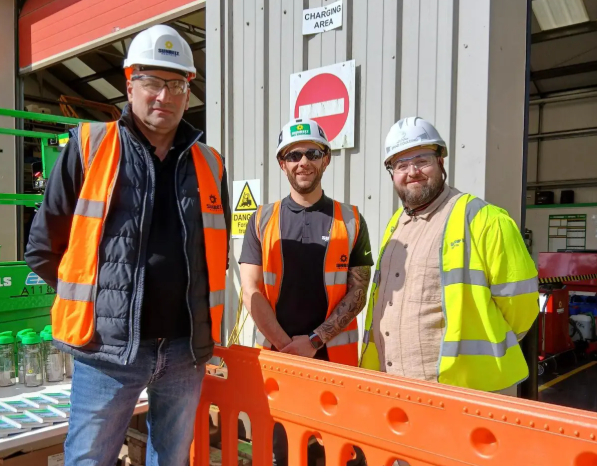
Cat Davies-McChesney, PPP Social Impact lead, right, with Rob Ward, Jordan Mattinson and Emma Williamson of Revive Furniture Recycling. Picture: Mark Regan.
Jobseekers across West Cumbria are getting extra support to move closer to work, thanks to grants worth more than £40,000 awarded through the PPP Social Impact Fund.
Managed by Cumbria Community Foundation and funded by Kellogg Brown and Root Ltd, Amentum Clean Energy Ltd, Morgan Sindall Infrastructure, and Altrad Babcock Ltd, the fund was created last year to help remove barriers to employment and open up new opportunities for local people.
Since launching, the fund has supported a range of organisations helping people build confidence, develop new skills and become work‑ready. This includes social enterprise Time to Change West Cumbria, the grant will help them support individuals seeking employment with essentials like CSCS cards, travel costs, and other practical items.
Other beneficiaries include People First Independent Advocacy, to fund a job coach for staff with learning disabilities and/or autism at Harbour Place Community Café in Workington; Revive Furniture Recycling, to aid the delivery of training and employment support for residents in Copeland who are unemployed or facing multiple barriers; and to Whamos Training and Development in Millom, to deliver one‑to‑one and small‑group sessions in digital skills, English, maths, life skills and employability.
Last year’s grants
And last year, the fund also supported Goodlives, which runs training centres in Cleator Moor and at West Lakes Science Park, to help adults facing long-term unemployment, social exclusion, or poor mental health develop skills and rebuild confidence on their journey into work.
Together, these grants are helping people build confidence, gain skills, and take meaningful steps into employment – strengthening communities and creating lasting impact across West Cumbria.
Steve Harnwell, PPP managing director, said: “I’m delighted to see our latest grants being awarded to such a mix of amazing community organisations. Each is doing incredible work investing in skills, training and giving people the confidence to pursue meaningful work.
“Our Social Impact Fund helps them to deliver this vital work by removing barriers to employment and creating opportunities that make a lasting difference to people’s lives.”
Progress continues with the installation of the first of two Bulk Storage Tanks (BSTs) being fitted into our SIXEP Continuity Plant (SCP). Due to their enormity, the tanks can’t be delivered to the Sellafield Ltd site fully built. Instead, they are transported in ‘tier’ sections and assembled on-site – there are five tier sections and a dished head for each tank.
Back in May last year, we reported the arrival of the first section of a BST, followed by the delivery and welding of the dished head’ in July. The project team has now reached another important stage with the safe delivery of the latest tier section, which will be welded beneath the upper sections already in place.
Once fully assembled, each tank will stand an impressive 14.8 metres tall and 7.6 metres in diameter.
The assembly is being carried out by Mammoet and Altrad Motherwell Bridge using a top‑down construction method. This involves suspending the structure from above and building it downward, beginning with the top dished head. In the most recent lift, the welded dished head and Tier 5 were raised to allow Tier 4, the latest arrival, to be positioned underneath.
A video of the lift – showing the dished head and Tier 5 being raised before Tier 4 is slid into place – can be viewed by clicking here.
Dave Devine, mechanical engineer, explained the level of planning involved in getting these components to site. He said:
“Before each component leaves Bendalls in Carlisle, the deliveries are meticulously planned between Altrad Motherwell Bridge, STL Logistics Ltd, the highways agency, and police. Once they arrive at Sellafield, the responsibility then includes the Aligned Delivery Team (ADT) to ensure there are no obstructions or other works on the route to the construction site, and then Mammoet unload them.”
The BSTs will play a vital role storing intermediate‑level waste (ILW), including spent sand and ion‑exchange materials produced during the plant’s effluent treatment process which removes radioactive substances from liquid waste streams from across the Sellafield site before the treated water is safely discharged to sea.
Following the progress update on SRP’s glovebox lines on our recent PPP townhall, and the spotlight on our supply partner NIS, we’re now focusing on the work of Ansaldo in Wolverhampton, where the group 300 and 500 glovebox lines are being manufactured for our Sellafield Product and Residue Store Retreatment Plant (SRP).
System 501 of the group 500 glovebox line.
The group 300 line is a powder retreatment line made up of 12 gloveboxes as part of 7 contained systems. This 25-metre-long line will be pivotal in retreating around 2,000 SNM packages.
The group 500 line is a residues retreatment line. This line is 41-metres-long, made up of 16 gloveboxes, and will be responsible for retreating around 6,000 SNM packages.
The group 500 line is the current focus. Factory Acceptance Testing (FAT) has been completed by Ansaldo, and equipment is now being transferred to our commissioning team in stages. The first Custody Transfer Certificate (CTC) has already handed over electrical distribution equipment, allowing the team to begin energisation of the plant in a controlled manner.
Batch furnace legs, part of the 23 meter glovebox line.System 505 and 508 of the 500 glovebox line.
Paul Carson-Clements, Commissioning section lead said: “Applying isolations was a key part of this work.
“It allowed us to demonstrate safe control of the systems, even while work continued downstream. My role was to oversee this process, keeping our team on schedule while working safely.”
The glovebox lines are designed to open, treat and repackage SNM packages, or cans, which will then be placed into long-term safe storage at Sellafield. Each line uses mainly automated processes, supported by operator input where required. Tools involved include package cutting, de-pressurising, repackaging and welding equipment.
Commissioning work is critical in proving the systems will do what they need to do, are safe and ready for arrival on site. Isolations and permits provide assurance to both PPP and Ansaldo that risks are understood and controlled before energisation.
The gloveboxes have been in manufacture and testing at Ansaldo for nearly two years, with transfers to PPP beginning three months ago. Despite the challenges of integrating into an established Sellafield process, cooperation between the teams has ensured progress has been safe and effective.
Looking ahead, energisation of the Group 500 line is planned to begin this month. This will see integration of supervisory control and data acquisition (SCADA) and programmable logic control (PLC) systems by the control systems team, marking a major step forward. As further equipment will be brought under PPP control, paving the way for input output checks and single item operations.
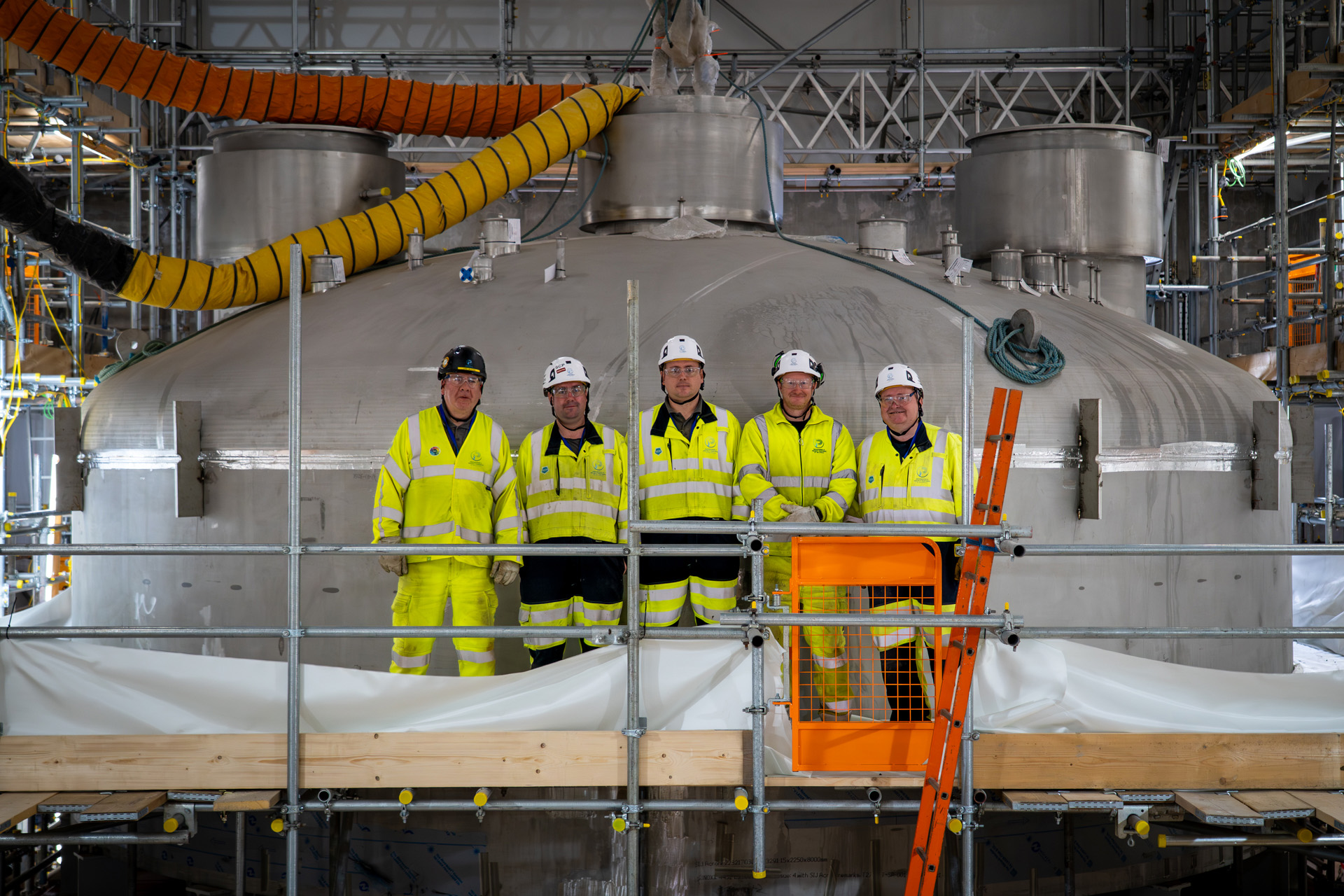
From left to right: Jimmy McGuigan (site supervisor), John Law (welder), Davie Hughes (welder), Will Stuart (temporary works coordinator) and Grant Dawson (welding inspector) with the bulk storage tank.
Back in May this year, we reported the arrival of the first section of a bulk storage tank, the largest that will go into our SIXEP Continuity Plant (SCP). Since then, progress continues to be made as welding of the tank sections gets underway.
Each tank measures 7.6 metres in diameter and stands 14.8 metres tall. Due to their large dimensions, unlike smaller vessels, the tanks can’t be delivered to the site fully built. Instead, they are transported in sections and assembled on-site.
The assembly is being carried out by Mammoet using a “top-down” construction method. This involves suspending the tank from above and building it downward, starting with the top dished head.
The contract for the two BSTs was awarded to Altrad Motherwell Bridge. The top dished heads were manufactured by König in Germany and completed by Bendalls Engineering in Carlisle, who fitted 36 nozzles and 3 large chimneys.
The BSTs are essential to the SCP’s operations. They will store intermediate-level waste (ILW), including spent sand and ion exchange materials. This waste is produced during the effluent treatment process, which removes radioactive substances from liquid waste streams. Once treated, the purified water is safely discharged to sea.
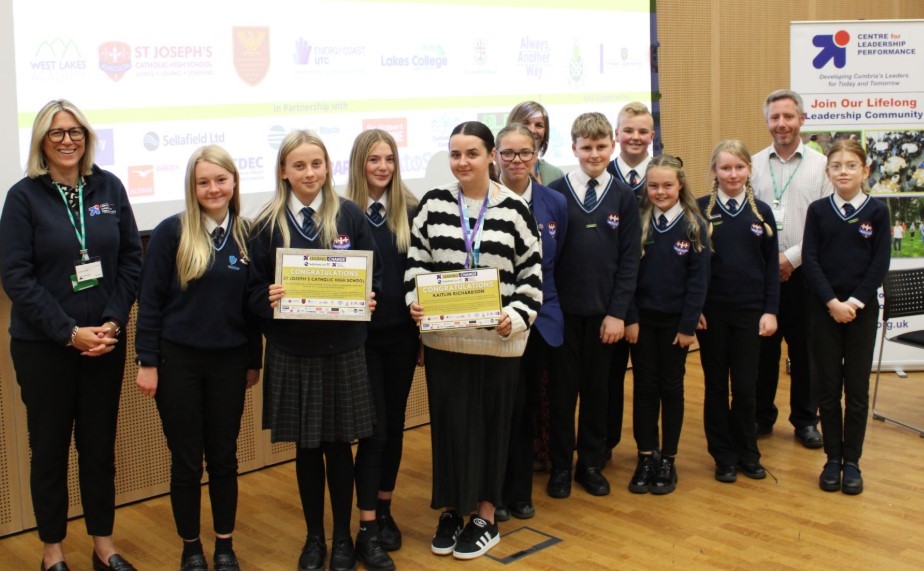
The Leading Change programme at St Joseph’s School.
Our Key Delivery Partner, Balfour Beatty Kilpatrick (BBK), has partnered with St Joseph’s Catholic High School to help students become agents of positive change in their community.
The Leading Change programme, developed by the Centre for Leadership Performance, aims to inspire secondary school students to broaden their horizons and take meaningful action.
It aligns with the engagement and volunteering theme of our social impact strategy, equipping young people with vital life skills such as leadership, teamwork, public speaking, and creative thinking.
At St Joseph’s, students identified three key focus areas inspired by the Millennium Development Goals: gender equality, wellbeing, and environmental sustainability. These priorities emerged from their own observations, including mental health challenges, access to sports facilities, and a need for greater environmental awareness.
Building on the success of last year’s wellbeing garden, this year’s cohort turned their attention to transforming the Year 7 yard — a space critical to helping new students transition smoothly into secondary school. Their vision? A more inclusive, engaging environment that supports mental health and fosters a sense of belonging.
Implementing Change
With creativity and determination, the students successfully pitched their ideas and secured funding for:
Social benches to encourage connection
Inclusive play equipment
Chalkboards and paint
Planters to promote biodiversity
Kaitlin Richardson, social impact co-ordinator for BBK, said: “The enthusiasm and dedication of these Year 7 and 9 students have been truly inspiring. After identifying key challenges, such as the need for more inclusive play spaces, rising concerns over mental health in young people, and environmentally friendly practices, they worked hard to bring their ideas to life.
“Building on last year’s wellbeing garden, our group set out to transform the Year 7 yard, creating a space that fosters inclusivity and sustainability, helping students transition smoothly into secondary school.”
Although the materials are ready, the final installation is awaiting a spell of dry weather. The full impact of the project will be seen in September, when the new Year 7 students arrive. A follow-up survey is planned to gather feedback and measure the initiative’s success.
Kaitlin added: “While there’s still work to be done, I couldn’t be prouder of what this team has achieved so far. They are a pleasure to work with, and it’s inspiring to see young people acting on their passion to drive real change. I’m looking forward to seeing this vision come to life!”
Congratulations to Altrad, this month’s Safety Energy contractor of the month on our Sellafield Product and Residue Store Retreatment Plant (SRP) project. The award was presented by Jon Muir, SRP construction manager.
Altrad earned this recognition for their open and honest approach to safety. The team used a section of the recent PPI Stand Down to reflect on a managerial failure elsewhere on site that led to a near miss, sharing key lessons and outlining what is now being done differently to prevent it from happening again.
This level of transparency and learning demonstrates Altrad’s commitment to safety and their proactive attitude to maintaining high standards on site.
Jon Pyne, Altrad senior project manager, said:
“I’m proud of the team for stepping up and showing leadership during the PPI Stand Down. We didn’t shy away from a difficult conversation, we used it to reinforce our commitment to learning, raising standards, and most importantly, keeping people safe.
“Everyone on our team has a role to play in driving safety forward, and this award is a credit to their efforts.”
Safety is at the heart of everything we do across our Major Projects at Sellafield. It drives our decisions, actions and culture. The inaugural Knowingly Safe 24/7 Awards shone a light on those who truly embody championing safety across our projects and supply chain.
Programme and Project Partners (PPP) head of EHSSQ and assurance, James Lewis, said: “Every step we take towards our goal of Knowingly Safe is made possible by operatives and teams who are visible, but equally those who quietly lead by example.
“These awards are a way of shining a light on their individual and team contributions – which are the backbone of our safety culture.
“Safety is a team effort across major projects and no contribution should go unseen.
“We received so many nominations, showcasing the incredible efforts being made to keep everyone safe every day.
“The standard was exceptionally high, which made for some tough decisions, and this is a true reflection of the collaboration and commitment to safety across Major Projects.
“This year’s winners have demonstrated exceptional leadership, innovation and care – going above and beyond to ensure the wellbeing of those around them.
“A sincere thank you goes out to everyone who took the time to submit nominations and congratulations to all our shortlisted nominees and our winners – you all help us on our journey to Knowingly Safe.”
Boots On Switch On PPI Award
The Boots On, Switch On, People Plant Interface award recognised a team or organisation that really stepped up during our recent PPI campaign – showing leadership, innovation, and a strong commitment to improving safety around people and plant interactions.
We asked our projects and supply chains to lead and support us, and the response was fantastic.
Our winner was the Severfield PPI Improvements Team who embraced the PPI campaign from the start – reviewing work methods, identifying improvements, and even helping shape practical demonstrations for the wider site. Their enthusiasm and ideas helped bring the campaign to life.
The Severfield PPI Improvements team with their award, flanked by James Lewis, head of EHSSQ, left, and delivery director Steve Harnwell, right.
Our two shortlisted finalists also deserve recognition for their outstanding efforts:
The Sellafield Product and Residue Store Retreatment Plant (SRP) Permit Improvements Team – This team introduced the Site Assist digital permit system, transforming how PPI is managed on-site. It’s improved communication, streamlined processes, and strengthened compliance across multiple contractors. A great example of innovation driving safer, more efficient working.
The SIXEP Continuity Plant (SCP) Aligned Delivery Team & Careys PPI Team – The SCP team, in partnership with Careys, delivered a powerful and practical safety stand down. From live demonstrations to bold visual aids and empowering plant operators, they created an experience that left a lasting impression and sparked real conversations about safer ways of working.
Knowingly Safe Champion
Our Knowingly Safe Champion Award is all about recognising individuals who go the extra mile to make sure their work is carried out in a Knowingly Safe way.
We had a lot of fantastic nominations for this category, which made narrowing it down no easy task. We short-listed five stand-out individuals – and from that group, we’re proud to say we selected not just one – but two winners!
Our winners were Steve Mitchell from March and Ian Reid from Altrad.
Knowingly Safe Champion Award – From left to right, James Lewis, head of EHSSQ, Knowingly Safe Champion award winners Ian Reid and Steve Mitchell, with Laura Doughty, head of strategy and stakeholders.
Steve Mitchell has set the gold standard for proactive safety engagement. With over 80 safety observations submitted this year, Steve consistently identifies and addresses potential hazards before they escalate.
He ensures compliance with Sellafield Ltd and Project Delivery Directorate (PDD) safety standards and never hesitates to reach out to the safety team when clarity is needed. Steve’s dedication is a shining example of what it means to lead by example.
Ian Reid joined the SIXEP Continuity Plant (SCP) project just eight weeks ago, but his impact has been immediate and profound. Drawing on years of experience across the Sellafield site, Ian has brought leadership, pride, and high standards to his team.
He’s known for his strong presence during POWRA and housekeeping discussions, and his exceptional three-way communication skills have earned praise from supervisors and scaffold engineers alike.
Special recognition also goes to our three shortlisted nominees who made this a tough category to call:
Pete Turner from Careys – Pete is a model of conscientious work and communication. He regularly exercises his stop work authority to ensure clarity and safety, and he’s always aware of how his tasks affect others. Pete’s attention to housekeeping and his commitment to leaving work areas clean and safe set him apart. His enthusiasm and strong communication make him a valued member of the team.
Steve Murdock from Cumbria Nuclear Solutions Ltd – As the project waste coordinator for the Civil Nuclear Constabulary Operations Unit (CNC OU) project, Steve plays a critical role in environmental protection and compliance. His meticulous management of waste segregation, skip logistics, and COSHH inventories has earned praise from Sellafield Ltd Intelligent
Client teams. Steve’s dedication extends beyond his role – he personally took on
improvements to quarantine arrangements following an incident, demonstrating his commitment to continuous improvement and safety excellence.
Darren Miles from Balfour Beatty Kilpatrick – Darren’s journey from operative to compound supervisor is a testament to his professionalism and drive. He has transformed the project’s waste management practices, eliminating non-compliances and introducing innovative solutions like a paint tin crusher and PPE
recycling. Darren’s initiative to donate reusable timber to local schools has created a lasting social impact. His work not only improves safety and sustainability but also strengthens community ties.
Knowingly Safe Supervisor Award
For the Knowingly Safe Supervisor Award, we looked for a supervisor who puts safety at the heart of everything they do. Whether it’s setting the tone for the day, leading by example, or supporting their team, these individuals make safety a priority every step of the way.
From left to right, James Lewis, head of EHSSQ, Robert Mellon of Design Grid and Brian Reid, of NG Bailey.
Our winner was Robert Mellon from Design Grid. Since stepping into a supervisor role over eight months ago, Robert has earned the full respect of his team and peers. He puts health and safety first in everything he does and was recently recognised with the Lindner Interiors’ Supervisor of the Year award for his commitment and leadership.
We had two more deserving finalists who deserve plaudits for their nominations:
Nigel Blacklock from Sir Robert McAlpine – Nigel is a long-standing and highly respected supervisor at SRM. Known for his calm leadership and deep site knowledge, he mentors others, leads by example, and brings a steady hand to every challenge. His return to work after a heart attack has only deepened the admiration and respect he commands across the site.
Ryan Martin from Severfield – Ryan is known for his openness, honesty, and high standards. He’s a strong advocate for the Knowingly Safe culture and has played a key role in improving Mobile Elevated Work Platform (MEWP) safety standards, even contributing to training content and video resources used across PDD.
Knowingly Safe Team Award
The Knowingly Safe Team Award recognises a group of individuals who consistently demonstrate safe behaviours and a strong safety culture in how they work together and deliver their tasks. Our winner’s dedication to building a strong, people-first safety culture is truly inspiring, and set them apart from the other very deserving finalists.
The Sir Robert McAlpine Site Establishment Team from BEPPS2 with James Lewis, head of EHSSQ, far left and Danielle Slattery, PPP head of lot 1, front right.
Our winner was the Sir Robert McAlpine Site Establishment Team from our Box Encapsulation Plant Product Store Two (BEPPS2). This team has set the tone for safety from day one. They lead by example – using Stop Work Authority confidently, maintaining tidy work areas, and creating a supportive, people-focused safety culture. Their approach is proactive, inclusive, and built on mutual respect.
Our congratulations also go to our shortlisted finalists:
SIXEP Continuity Plant (SCP) Construction Team including Altrad, Mammoet and their supply chain – The SCP team showed what great planning and teamwork look like during the delivery of the Bulk Storage Tank. From daily readiness reviews to post-job learning, they demonstrated strong communication, collaboration, and a clear commitment to doing the job safely – even when it meant pausing to rest and reset.
Dale Barcock, Barry Boyd & Martin Kellett – This trio has played a key role in raising safety standards around trench support and temporary works. Their leadership has not only improved safety but also boosted efficiency across the project – proving that safety and productivity go hand in hand.
Knowingly Safe Rising Star Award
The Knowingly Safe Rising Star Award recognises someone early in their career who’s made an immediate and meaningful impact. These are the individuals who bring energy, fresh ideas, and a real passion for safety – people who don’t just follow the rules, but actively shape the culture around them.
From left to right, James Lewis, head of EHSSQ, Lauren Johnston, of Amentum, and Thomas Hyland, of Balfour Beatty Kilpatrick.
Congratulations to our winner, Lauren Johnston, from Amentum, who works on our Civil Nuclear Constabulary Operations Unit (CNC OU) project. Lauren joined the CNC project just over a year ago and has quickly become a key figure in driving health and safety across the consortium. From rolling out new site-wide procedures to leading fire safety planning and training, Lauren has shown leadership well beyond her years.
Her work has helped raise compliance standards across the board – and her commitment has been recognised with a RoSPA Gold Award for the project. She’s seen as a go-to person by everyone on site.
There are a lot of talented rising stars across major projects and recognition is definitely deserved by our two shortlisted finalists:
George Tyson from Sir Robert McAlpine – Box Encapsulation Plant Product Store Two (BEPPS2) – George is a working supervisor and safety rep at SRM who leads from the front. He’s approachable, proactive, and always ready to raise concerns or share ideas to improve safety. Whether it’s through toolbox talks or informal chats, George promotes a culture of openness and responsibility. His influence on the ground is clear – and his passion for safety is contagious.
Stacie Davies from Altrad – Since joining the SIXEP Continuity Plant (SCP), Stacie has taken the lead on mental health in a way we’ve never seen before on PPP. She organised an off-site event with three specialist speakers, tailored to different learning styles and focused especially on site operatives – who often miss out on this kind of engagement. It’s a fresh, inclusive approach that’s already making a difference, and it’s just one of several initiatives Stacie is driving forward.
Knowingly Safe Innovation Award
Innovation and learning is a key part of building a safer future – and that’s exactly what our Knowingly Safe Innovation Award is about. It recognises an individual, team, or organisation that has gone above and beyond to bring new thinking, smarter solutions, and meaningful improvements to safety – whether that’s through technology, process changes, or lessons learned that benefit the wider industry.
We received some truly impressive nominations for this category, and it’s clear that innovation is happening all the time across our projects.
The i3 Coatings Team from SRP receive their award from James Lewis, head of EHSSQ, far left and Kim Chester, PPP head of lot 2, far right.
Our winners of the Innovation Award were the i3 Coatings Team on our Sellafield Product and Residue Store Retreatment Plant (SRP). The i3 team has taken a proactive, data-driven approach to health and safety on the SRP project. They’ve introduced real-time monitoring for vibration and dust exposure, using wearable tech and integrated analytics platforms – giving supervisors live alerts and enabling immediate action. They’ve also trialled slip-resistance testing and upgraded respiratory protection, all with the goal of protecting workers and improving long-term health outcomes. It’s a brilliant example of how technology and evidence-based thinking can drive real change.
Innovation doesn’t just mean new gadgets – it means thinking differently, challenging the norm both on Sellafield and within the industry, and finding better ways to keep people safe, so congratulations to all our shortlisted finalists:
The Sunbelt Powered Access Team – Sunbelt has made a major impact on safety at height – investing in new technologies like the EQSS Over Watch system for scissor lifts and supporting its roll-out across over 100 MEWPs on Sellafield projects. They’ve also led the way in digital planning tools, using building information modelling (BIM) and augmented reality to help teams choose the right equipment and reduce risk before work even begins. Their commitment to innovation and collaboration is helping raise the bar across the industry.
The Architectural Fit Out Team on Sellafield Product and Residue Store Retreatment Plant (SRP) – Faced with the challenges of traditional decontamination paint methods, this team took a step back and re-imagined the process. They explored alternative materials, collaborated with suppliers, and developed a brand-new panel system specifically designed for Sellafield. The result? A safer, faster, and more efficient solution that reduces dust, noise, and hand, arm, vibration syndrome risks – and has the potential to be adopted across the wider nuclear sector. It’s a fantastic example of innovation driven by both safety and practicality.
Courage to Care 24/7 Award
This award is something truly special – the Courage to Care 24/7 Award. This award recognises someone who lives our Knowingly Safe values not just at work, but out in the wider community.
It’s for those who go above and beyond to make a difference in people’s lives – showing care, compassion, and leadership when no one’s watching and there’s no spotlight.
From left to right, James Lewis, head of EHSSQ, Danielle Bailey and Craig Peggie, of Sir Robert McAlpine.
The award went to Danielle Bailey from Morgan Sindall Infrastructure, who works on our Sellafield Product and Residue Store Retreatment Plant (SRP) – Danielle has made a huge difference through her work on mental health – both inside and outside of work. As co-chair of the SRP Mental Health First Aiders Forum, she’s led initiatives like Wellbeing Wednesdays, which include on-site support and off-site group walks to encourage open conversations. Her leadership has helped create a culture of care and connection across the team.
The actions of all our nominees remind us that safety and wellbeing don’t stop at the site gate – they’re part of who we are, every day. Special recognition goes to the shortlisted finalists:
Tom Maguire from KBR – Tom has dedicated over 500 hours of voluntary service as a Special Constable with Cumbria Police – on top of his full-time role in PPP/KBR. He works weekends, takes on the same risks as regular officers, and is even training for blue light response. Tom’s commit-ment to public safety is a powerful example of courage and care in action.
Sebastian Zurek from Careys – Sebastian is a true community champion. From charity walks and local projects to helping elderly neighbours and restoring a memorial bench – he’s always looking for ways to give back. He brings the same care and professionalism to his day job, making his impact even more inspiring.
Knowingly Safe Leader Award
The Knowingly Safe Leader Award recognises one of our many outstanding leaders who consistently champions the Knowingly Safe culture. This award is about more than just job titles. It’s about the individuals who lead by example, who empower others to speak up, and who create an environment where safety isn’t just a priority – it’s a shared value, embedded in everything we do.
Our Knowingly Safe Leader Award winner John Leslie, centre, with James Lewis, head of EHSSQ, and Susan Mackenzie, corporate head of safety, safeguards and quality.
Across the programme, we’re fortunate to have many brilliant leaders who fit that description but our winner truly embodies what it means to be a leader on a major project.
Congratulations goes to John Leslie, from Morgan Sindall Infrastructure and project director of our Sellafield Product and Residue Store Retreatment Plant (SRP). John’s leadership is consistent, visible, and grounded in genuine engagement with his team.
He always makes time – whether it’s to support a colleague, reinforce safety expectations, or simply listen. He has played a pivotal role in shaping the safety culture at SRP.
Under his leadership, the team has created an environment where people feel confident to report concerns, near misses, and incidents without hesitation.
In fact, earlier this year, there was a noticeable shift in reporting behaviours – driven by his encouragement and example – which has had a lasting positive impact on the project’s safety performance.
Knowingly Safe Supply Chain Award
The Knowingly Safe Supply Chain Award recognises our many brilliant supply chain partners, who all contribute to making our projects and our site Knowingly Safe.
The award went to a partner who really excels in their commitment to being Knowingly Safe and consistently contributes to the wider programme through sharing learning, bringing new innovations and just demonstrating excellence in everything they do.
Knowingly Safe Supply Chain award – Representatives from NG Bailey celebrate their award win with James Lewis, head of EHSSQ, far left and John Rossiter, PPP’s head of supply chain and commercial, far right.
After much deliberation, the winner was NG Bailey, who continues to raise the bar when it comes to safety performance and innovation.
They’ve brought fresh ideas and technologies into the Safety Hub, consistently delivering high standards in Safety Energy and compliance. Their leadership team is highly visible and engaged, and their focus on SQEP has helped drive a culture of competence and accountability.
Operatives and supervisors from NG Bailey are regularly recognised for their positive contributions to project safety and for supporting wider programme initiatives. They are a strong, consistent presence in the Safety Hub and a valued partner.
This award proved tough to narrow down to just three nominees, given the excellent partners we have within our supply chain, but praise also goes to our shortlisted finalists:
Keltbray – Keltbray has shown a clear commitment to improving safety culture and workforce engagement across the programme. What really sets them apart is their proactive involvement in the Safety Hub – despite not being required to participate, they’ve actively sought out opportunities to contribute and be part of the solution.
They’ve also been pioneers in People Plant Interface (PPI) safety, leading the way with proximity warning systems and playing a key role in shaping the early development of the PPI standard. Their forward-thinking approach and willingness to collaborate have made a real impact and paved the way for the standard to take shape.
Balfour Beatty Kilpatrick – Firstly, BBK have been a truly proactive and committed member of the Safety Hub since its formation, supporting a range of initiatives and always bringing a collaborative mindset. One stand-out contribution has been their work on fatigue management, including a trial with a leading third-party provider to explore new ways of managing this critical risk which has typically been difficult to control across the industry. In addition, their leadership has shown strong commitment to safety, and their workforce continues to deliver high standards across the programme. BBK’s willingness to engage, share learning, and support innovation makes them a key player in our collective journey towards Knowingly Safe.
Delivery Director, Steve Harnwell, who attended the event, said: “What’s important is that we do recognise good safety behaviours and where people, most of the time, will do everything right and keep people safe.
“Sometimes we get too focused on the negative side of safety where somebody is hurt, or something hasn’t gone to plan.
“It’s really important to look and learn, but what we shouldn’t lose sight of is when people are doing it well, and we should thank people for it because that’s how we get a better culture, a better attitude and ultimately a better form of safety.”
As part of on-going efforts to reduce the risks associated with working at height, a newly revised Mobile Elevated Work Platform ( MEWP ) standard has been issued across major projects at Sellafield, incorporating valuable insights and lessons learned over the past 12 months.
Originally introduced in February last year, the MEWP standard was developed by the Health, Safety and Wellbeing Hub to enhance safety measures for working at height across all our projects.
This has led to the appointment of over 40 MEWP co-ordinators and the replacement of a host of MEWPs with models that now have enhanced safety features. New MEWP management plans were also introduced across the supply chain.
This updated version builds on that foundation, ensuring our practices remain aligned with the highest safety standards and reflect our ongoing commitment to continuous improvement.
Within the construction industry, incidents involving MEWPs occur at three times the rate seen in other sectors. We’re determined to stay ahead of that curve and ensure that everyone working with MEWPs is Knowingly Safe.
The use of MEWPs has increased significantly across major projects, driven by the progression of several in-flight projects through various construction phases. Over the past 12 months, the Hub has reviewed our progress and incorporated lessons learned into revision two of the standard.
Key updates
Some of the key highlights are that it is now mandatory that all scissor platforms must have electronic secondary guarding as a feature. And the MEWP hazard screening sheet has been updated following 12 months of learning.
Additional clarity has also been added with new sections on disciplined MEWP operations and emergency arrangements following Hub feedback.
There is an updated criteria for defining complex tasks and definitions introduced for two-handed controls and intelligent anchor points – the latter in response to learning from one of our projects.
This revision marks a significant step forward in our journey to make working at height safer and more efficient. By embedding these changes, we continue to lead the way in construction safety and ensure that every team member working with MEWPs is equipped with the knowledge and tools to operate safely.
MEWP co-ordinators from each organisation are set to attend an upcoming Major Projects MEWP co-ordinator session. This session will cover the revised standard in detail, provide an opportunity to raise any issues or feedback, and include a meeting with Steve Harnwell, major projects delivery director, the executive sponsor for the MEWP standard.
Pride in MEWP Standard
Mark Atkinson, health and safety manager on our Sellafield Product and Residue Store Retreatment Plant (SRP), said: “We are very proud of our MEWP standard. Its focus is beyond compliance and we believe powered access safety should be a culture, not a checklist.
“Powered access equipment is widely regarded as one of the safest methods for enabling work at height but, like any equipment, there is always scope for further improvements in its safe use.
“With work at height continuing to pose one of the most significant risks across major projects and broader industries, I believe this standard will keep us ahead of the curve.
“If you are not aware of it, and are influencing MEWP work within your organisation, please review the update and its safety critical information.”
(L-R) Mike Harrison (Major Projects Powered Access for Sunbelt), Ryan Capitano (Sales Director for Sunbelt), Bradley Goulding (organiser) BBK Health, Safety & Wellbeing Advisor.
Our SIXEP Continuity Plant (SCP) team recently attended a safety stand down with Sunbelt Rentals in Whitehaven, alongside our supply chain partner, Balfour Beatty Kilpatrick.
The event was set up as a response to operative feedback about challenges using mobile elevating work platforms (MEWPs) and the enhanced safety mechanisms being used on our construction sites. With a number of new operatives recently joining the project, it was also a timely opportunity for familiarisation and hands on learning.
Mike Harrison, Sunbelt major projects powered access lead, and Ryan Capitano, Sunbelt head of sales, delivered an excellent demonstration of the improved equipment safety systems (EQSS) on the MEWPs. The session gave our operatives the chance to gain first-hand experience with the enhanced technologies, and to engage directly with the manufacturer to ask questions and share feedback.
Molly Young, SCP ADT Health and Safety Advisor, said:
“It was great to hear our operatives sharing their own experiences of how this innovation could support them at the workface. It’s fantastic to see our suppliers working collaboratively with us to ensure we have the best possible equipment on site.”
Bradley Goulding, Health, Safety and Wellbeing Advisor on SCP, added:
“The event went really well. The operatives were engaged and asked a lot of good questions. They also made some good challenges to the manufacturer, highlighting the issues they are facing and what could be changed to improve the system.
“Ryan Capitano demonstrated the EQSS system against another system and also the upgrade to the EQSS system, which was all about making it more user-friendly, one of the main concerns raised by our team. A lot of those concerns were addressed, and the operatives got the opportunity to test the upgraded system at the workshop, where the improvements received a resounding thumbs up. The difference was described as ‘night and day.’”
The Safety Stand Down served several key purposes:
It provided vital familiarisation for new operatives unfamiliar with the EQSS system.
It created a platform for direct dialogue between our team and the manufacturer and supplier, helping to resolve ongoing issues.
It reinforced our commitment to listening to our operative’s concerns and actively seeking practical, market-ready solutions.
It allowed us to gather feedback on the system upgrades directly from those using the equipment day to day.
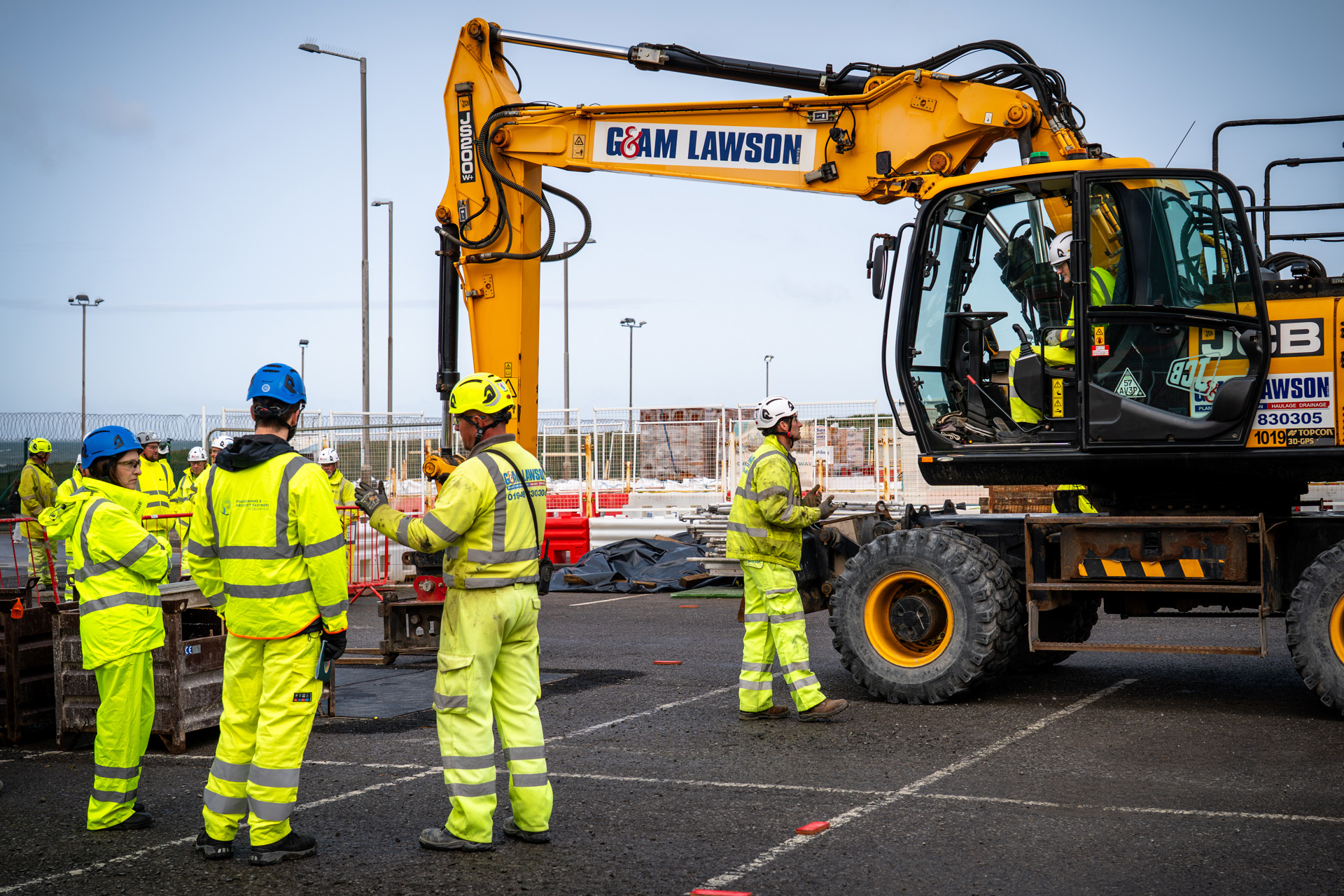
Andrew Lawson (centre) discussing the Spillard PPI system to the machine driver.
In an industry where people and machinery operate side-by-side every day, reinforcing the importance of the People Plant Interface (PPI) Life Saving Principle is essential to keep us Knowingly Safe.
Recently, our Sellafield Product and Residue Store Retreatment Plant (SRP) project team paused operations for a Safety Stand Down, focusing on PPI, bringing together teams from across our supply chain to focus on staying safe around plant and equipment.
Companies across the project set up practical PPI stations, with live demonstrations of operations, showcasing systems, technologies, and behaviours used to manage and mitigate PPI risks, in line with our PPI campaign.
From spotter communication methods to proximity sensor demonstrations, each session offered hands-on, real-world insights into preventing harm where it matters most.
Andrew Lawson was demonstrating the Spillard PPI system which helps reduce plant-related risks by alerting both vehicle operators and personnel when they are in proximity to moving equipment.
He said: “The most important thing to me about PPI as a plant operator is people sticking to footpaths and not encroaching on work areas. People can sometimes come into areas that they don’t need to be in. Stick to the footpaths and you won’t come into contact with the plant.”
Contractor-led PPI stand down
Mark Atkinson, SRP health & safety manager, said: “To enhance site safety and operational understanding, the SRP People Plant Interface (PPI) Safety Stand Down was organised with a strong emphasis on being contractor-led, ensuring that the valuable expertise and real-world experience of our plant operators and contractors were at the forefront.
“The day focused on engaging directly with those who work daily with plant machinery, using their insights to identify key interface risks, share best practices, and develop practical solutions for improving safety around plant operations.
“Refresher training, demonstrations, and open-floor discussions allowed contractors to lead the conversation, demonstrating best practice whilst giving voice to those most affected by PPI challenges.
“Recognising the size and influence of our management team, we also arranged for a plant simulator to be positioned on site for two days. This provided non-operational staff with a hands-on opportunity to experience the challenges of operating heavy machinery within the constraints of a tight, live construction site.
“The simulator exercise significantly improved empathy and understanding of the spatial awareness, concentration, and skill required to operate plant safely in dynamic environments. This is understanding is key for safely planning future works.
“The Stand Down promoted collaboration, strengthened relationships between management and site teams, whilst reinforcing our commitment to safety through mutual respect and shared learning.
“I would personally like to thank everyone involved with the Stand Down.”
Close proximity working
Greg Doran, SRP SHE lead, added: “Following the Stand Down, the SRP leadership team took the opportunity to mandate close proximity working by exception only, for example, for specific and very necessary reasons and this will be implemented from 9 June.
“The reason for the mandate is to discourage people from defaulting to close proximity working initially; instead, we believe people and plant should be separated wherever possible.
“However, we also recognise that there will be exceptions where people and plant need to interface due to the nature of the task.”
Steve Harnwell, delivery director, said: “On busy construction sites, like SRP, where we are doing 5.2 million hours of high hazard construction work, one of the biggest risks to people is moving machinery, whether you are using it or are a pedestrian on the site.
“It’s important to follow our Life Saving Principle for PPI. We have segregated walkways to protect people from moving vehicles but, equally, if you are involved in the work, it’s important to follow the rules around the safety measures that we put in place.”