
An insightful piece from our Director of Markets and Supply Chain, Emma Whigham.
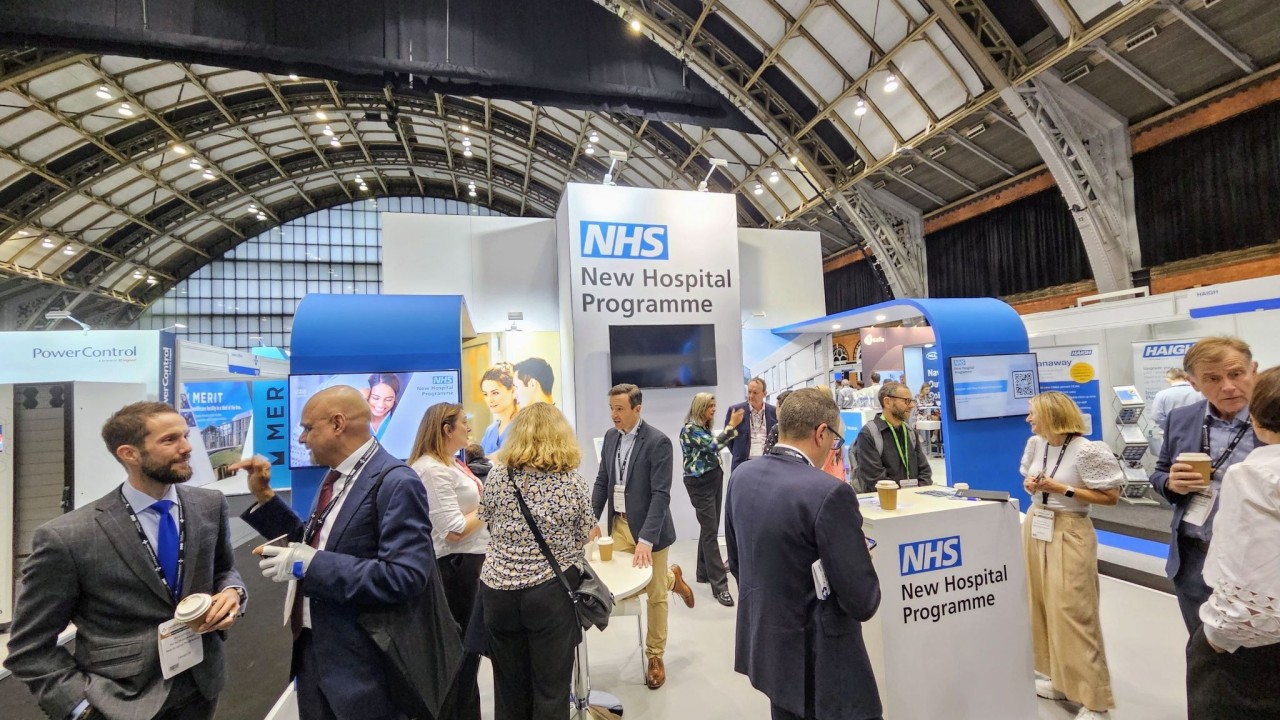
It was great to talk to so many suppliers at the IHEEM Healthcare Estates Conference on Tuesday in Manchester and see the growing interest and excitement there is in the industry for the New Hospital Programme (NHP).
Many businesses told me that they were interested to hear more about what we are looking to achieve on NHP and to find out about how we are engaging with the market to shape our commercial approach.
The NHP is currently one of the largest infrastructure programmes in the UK and arguably one of the most important. We have a significant and essential opportunity to transform the way we deliver healthcare infrastructure for the NHS.
I can personally give testament to the difference a new facility can make – I grew up in the South side of Birmingham where we used to have the old Victorian hospital in Selly Oak but now, we have the modern Queen Elizabeth Hospital in Edgbaston. This change has made a huge difference – we went from having something dark, with paint peeling off the walls and small hospital rooms to something light and airy!
Our Commercial Strategy has so far been focused on the biggest contracts we need – the Programme Delivery Partner and Main Works Partner contracts. These are close to completion and close to starting procurement respectively.
However, our market analysis has gone so much further than this and has come across a broad spectrum of challenges across the supply chain to deliver these hospitals. This analysis helps us to determine where to focus our efforts – so that we concentrate on the things that make the biggest difference.
As an example – it will not come as surprise that MEP makes up a massive proportion of hospitals (we estimate 35-40% of the delivery cost of a hospital is MEP for NHP) and so poses a significant risk to delivery. We know that there is a capacity gap for what we want to deliver (due to a shortage of skills and labour, bespoke ways of doing things, not enough offsite activity etc). We also recognise that strong relationships exist between Main Works Contractors and their MEP suppliers. So, any solutions we develop must take account of these factors. We’ve been working with Main Works Contractor and MEP suppliers to understand this and develop the right commercial approach.
Other priority areas in the Tier 2 and 3 markets where we have identified challenges include facades and common components. We are engaging with these supply chain markets to test our procurement and commercial approaches in these areas too.
But once the risks are identified, how do we plan to intervene in order to mitigate them?
Here are just some of the critical interventions that will help us to significantly mitigate risks and have broader benefits:
· Regional supply chain strategies:
We recognise that no one part of England is the same. For example, the challenges in the South West are different to the Midlands, East and North). We need to identify and focus on what makes success at local level – smoothing potential bottlenecks and regional supply chain shortages whilst also enabling on time delivery for construction.
· Prototyping:
Hospital 2.0 is our platform for delivery for delivering hospitals for the future. It is our standard design kit, set of rules, processes and the building blocks for delivering hospitals. It is built upon solid foundations but contains new (and in some cases untested in this scenario) elements. We are looking at how we test the novel aspects and work with different parts of the market to prototype different parts.
Look out for more information on Hospital 2.0 in a future blog.
As we approach the start of the Main Works Partners procurement, we are focusing our efforts on those parts of the supply chain that are very important to us in the delivery of hospitals – and we’ve seen from other programmes that the small and medium sized enterprises at the lower tiers of the supply chain are often critical to deliver a programme of this size.
There is a lot more work to do – and we plan to continue to engage extensively with the market. But we are confident that our work identifying challenges, mitigating risks and shaping the market will put us in the best possible position to deliver this transformational and critically important programme.